
Most emergency food kits are built around a simple assumption: that you will have the time, fuel, and clean water to cook. That assumption falls apart in a real crisis.
Canned goods need a can opener. Many freeze-dried meals are designed for hot-water preparation, although some can rehydrate with cold water and extra time. Bulk grains need hours of soaking and simmering. When the power is out and water is tight, the food you stored becomes a puzzle you have to solve while stressed, tired, and hungry. The best emergency food is not the one with the longest shelf life on paper. It is the one you can actually eat when everything else has gone wrong.
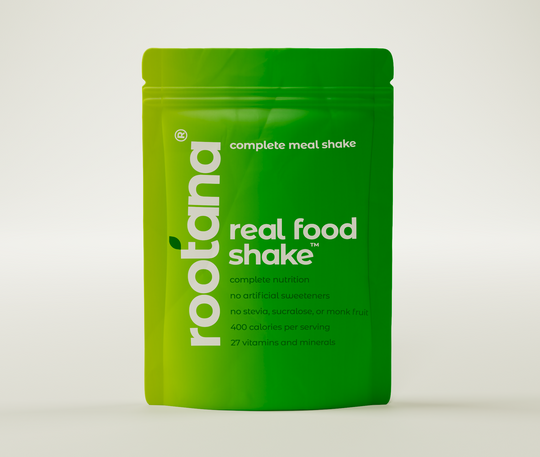
That is the gap Rootana fills. It is a complete meal in a powder form, built to deliver serious calories and real nutrition without a stove, a fridge, or a pile of cookware to clean afterward.
What Emergency Food Planning Usually Gets Wrong
American Red Cross guidance on emergency food is clear on the basics. Choose non-perishable, easy-to-prepare foods. It recommends a three-day supply for evacuation and a two-week supply for staying home. Water matters just as much, at one US gallon (about 3.8 liters) per person per day.
Those guidelines are sound. The problem is what people actually buy to meet them.
Many emergency kits lean heavily on carbohydrates like rice, pasta, and crackers. They provide useful calories, but a supply based mainly on refined carbohydrates can be short on protein, fiber, and micronutrient variety. Plain crackers and canned soup are useful items, but a broader mix of foods makes a more balanced supply.
There is also the cooking problem. Freeze-dried meal pouches are popular because they are light and store for years. Hot water makes preparation quicker, although some products can also be prepared cold. The rehydration requirement varies by product, so check the water instructions on each pouch. That is water you have to carry, store, and possibly ration. If you are using a camp stove to boil that water, you also need fuel. In a scenario where the power is out for days and water lines are compromised, you need to budget for preparation, drinking, and hygiene. Water absorbed into a meal still contributes to fluid intake.
There is also the rotation problem. Food you store and forget about goes bad. Emergency management guidance recommends storing food in a cool, dry, dark place and rotating your stock. But if your emergency supply is a bucket of wheat berries you have never cooked, rotation is a chore you will avoid. The food sits there until it expires or until you need it and discover you do not want to eat it.
A Quick Tour of the Usual Emergency Food Options
To understand where Rootana fits, it helps to look at what most people actually store, and where each option falls short.
Canned goods are the classic starting point. They are cheap, familiar, and widely recommended by health departments. Storage life varies: many low-acid canned foods last two to five years, while acidic foods such as some fruits have shorter storage lives. Follow the product guidance and check the condition of the can. The drawbacks are weight and preparation. A case of canned food is heavy, and many canned meals need a heat source to be palatable. You also need a manual can opener, which is easy to forget until you need it.
MREs (Meals Ready to Eat) are military-style ration packs. They require no added water to eat, which is a real advantage when water is scarce. Shelf life varies widely with storage temperature and the individual ration. Check the pack date and the manufacturer’s storage guidance. MREs are heavy and bulky relative to their calories, and the taste is functional at best. They are a solid choice for a vehicle kit or a short-term go-bag, but storing months of MREs for a family takes up a lot of space.
Freeze-dried meals are the lightweight champion. A pouch of Mountain House or a similar brand rehydrates with hot water in under ten minutes and tastes far better than an MRE. Shelf life can extend for years or decades, depending on the product and storage conditions. Follow the manufacturer’s stated shelf life. The catch is the rehydration requirement. You need safe water and enough time to prepare the meal. Some products can be made with cold water, but they take longer; check the instructions for the specific product.
Food buckets and kits are the bulk option. A 72-hour kit from ReadyWise or a similar brand might contain 30 servings of freeze-dried meals with a 25-year shelf life. The problem is calorie density and serving size. A review of budget buckets notes that many list servings in the 180 to 220 calorie range, which means an adult needs multiple servings to reach a realistic daily intake. You end up opening several pouches per meal, which burns through your supply faster than the serving count suggests.
Energy bars and ration bars are the no-cook fallback. A 400-calorie bar can be eaten on the move without water or fuel. They are useful as a supplement, but they are not a meal. Many lack the protein, fiber, and micronutrient profile of a complete meal, and eating nothing but bars for days wears on morale and digestion.
Dry staples like rice, beans, oats, and pasta are cheap and store for years. They are also the least convenient option in a crisis. They require significant water and fuel to cook, and they demand a functioning kitchen. If you have a working stove and a deep pantry, they are excellent. If you do not, they are a liability.
Why a Powdered Complete Meal Belongs in Your Kit
Powdered meal shakes solve a specific set of problems that the options above do not.
Their low moisture content helps them remain shelf-stable when stored as directed. They are compact and light compared to cans or MREs. And they require nothing more than water and a shaker bottle to prepare. No stove. No fuel. No pot to scrub.
There is a reason military and aerospace researchers have explored meal replacement powders for personnel in high-stress, low-resource environments. A meal that can be mixed and consumed quickly, without cooking, fills a real gap when people are expending energy but not eating enough of their standard rations. The logic applies just as well to a family sheltering at home after a storm or sitting in an evacuation center.
Rootana takes that concept and makes it practical for everyday preparedness. It is not a protein shake with a few vitamins tossed in. It is formulated as a complete meal, with a macronutrient split built around oats, plant protein, and healthy fats.
Why Rootana Is the Best Complete Meal Shake for Emergencies
Plenty of shakes claim to be meal replacements. Few are built for the specific demands of an emergency. Here is what sets Rootana apart.
The calorie math actually works. Emergency food is only useful if it delivers enough energy to keep you functioning. Rootana delivers 400 calories per 100-gram serving. Each pouch contains 14 meals, or around 5,600 calories in total. That number matters more than it looks. A typical food bucket serving often lands in the 180 to 220 calorie range, which means an adult needs multiple servings per meal just to hit a basic daily intake. Rootana gives you a complete meal in a measured 100-gram serving, with a clear calorie count that makes your supply easier to plan.
The nutrition is complete, not just caloric. Many emergency foods are calorie delivery vehicles with little else. Crackers, white rice, and ration bars fill your stomach but leave your body short on the micronutrients it needs under stress. Rootana provides 20 grams of plant protein, 7 to 9 grams of fiber, and 27 essential vitamins and minerals at 20% or more of the reference intake per serving. The calories come from complex carbohydrates (around 42 percent), plant protein (20 percent), and healthy fats (33 percent, including omega-3, 6, and 9). That is a meal designed to keep you full and steady, not spike and crash.
The ingredient list is short and recognizable. Oat flour, pea protein isolate, organic coconut sugar, golden flaxseed, sunflower oil, and a vitamin and mineral blend. Rootana is plant-based, lactose-free, soy-free, and non-GMO. It is also free from sucralose, stevia, monk fruit, and maltodextrin, using a small amount of organic coconut sugar instead. That matters for two reasons. First, people who prefer to avoid high-intensity sweeteners have a straightforward alternative. Second, a meal that does not taste artificial is a meal you will actually eat and rotate.
No stove, no fuel, no problem. The single biggest failure point in most emergency food plans is the assumption that you will have heat. Rootana mixes with 400 to 500 milliliters of water at room temperature. Shake and it is ready in under a minute. No flame. No fuel canister. No pot to scrub afterward. When the power is out and you are rationing water, that difference is enormous. You avoid boiling a pot of water, although you still need to keep your shaker clean. You are not competing for stove space. You are just eating.
Storage and rotation you will actually maintain. Rootana comes in resealable, lightweight pouches that store easily in a cool, dry cupboard or a go-bag kept within the storage conditions on the label. Because it is a meal you can drink in normal times too, rotation happens naturally. You use a serving for breakfast, replenish the pouch as it runs down, and your stock stays current without a spreadsheet or a reminder on your phone. The best emergency food is the food you actually eat, because that is the only food you actually rotate.
It fits the guidance. Emergency management guidance stresses foods that need no refrigeration, no cooking, and no special tools. Rootana checks every box. It removes the need to heat water, while still requiring safe drinking water for mixing. You still need safe water to mix it and enough water to clean your shaker, but you do not need to boil water to prepare the meal.
Storage, Preparation, and the Water Question
Rootana comes in resealable pouches that are lightweight and designed to prevent spills. The powder is shelf-stable and needs no refrigeration. You add 400 to 500 milliliters of water, shake, and the meal is ready. No stove. No fuel. No pots to scrub.
The water requirement is worth being honest about. You still need clean water to mix the shake. You do not need water for boiling a pot, although your shaker still needs cleaning. Compare the preparation instructions for the foods in your kit: some freeze-dried meals can be prepared and eaten directly in their pouch. Rootana avoids the need for heat, but its water requirement still needs to be included in your plan. It does not necessarily use less water than a freeze-dried meal.
For storage, the rules are the same as any dry good. Keep pouches in a cool, dry place away from direct sunlight. Rotate them periodically so your supply stays fresh. Because Rootana is a meal you can drink in normal times too, rotation is easier than it is with a bucket of survival food you never touch. You can use a serving for breakfast or lunch, replenish your supply, and keep the stock current without thinking about it.
What Rootana Is Not
Rootana is not a replacement for water storage. No food is. US guidance recommends at least one US gallon (about 3.8 liters) per person per day for drinking and basic hygiene. Rootana is not a long-term substitute for a varied diet over months or years. No single food is. And it is not the only thing you should store. A sensible emergency pantry includes canned goods, nut butters, crackers, dried fruit, and treats for morale. Variety matters, both for nutrition and for the psychological comfort of eating something familiar.
What Rootana is, is a reliable meal that closes a specific gap. It is the food you reach for when you need calories and nutrition quickly, without fuel or fuss. It is the pouch you keep in a cool, dry place and rotate before its best-before date. It is the meal that does not demand anything from you except water and a few seconds of shaking.
Building a Layered Supply
The most practical approach to emergency food is not to pick one option and commit to it exclusively. It is to build layers, each one covering a different scenario.
Layer one: no-cook, no-fuel meals for the first 72 hours. This is your go-bag and your car kit. You may have no power, no water pressure, and no time to cook. Rootana fits here, alongside energy bars and ready-to-eat canned goods with pop-top lids. The goal is calories and nutrition you can access immediately, with minimal water and no heat.
Layer two: your home pantry for a two-week shelter-in-place. This is where canned goods, dry staples, and an outdoor cooking stove come in. You have more space and more time. You can cook, assuming you have fuel and water. Rootana still earns a place here as a backup for days when cooking is impractical or when you need a quick meal that does not compete for stove space.
Layer three: long-term storage for extended disruption. This is the domain of freeze-dried #10 cans, bulk grains in mylar, and other foods with multi-year shelf lives. These options require the most preparation and the most water, but they offer the longest horizon. Rootana is not designed for a five-year bunker stash, but it can rotate through your normal routine and stay fresh because you actually use it.
The mistake is treating any single option as a complete plan. A bucket of meals that require cooking, with no way to cook them, leaves a gap in your plan. A shelf of canned goods with no can opener is a plan that fails on day one. A bag of Rootana with no water is a plan that fails on day one. The goal is redundancy: multiple ways to eat, multiple ways to prepare, and multiple sources of calories and nutrition.
The Practical Case for Rootana
Emergency preparedness is not about buying the most gear or building the biggest pantry. It is about making sure that when something goes wrong, you have options that actually work. Food that requires cooking is an option only if you have fuel and water to spare. Food you do not like is an option only if you are desperate enough to eat it anyway. Food that sits in a bucket for a decade and never gets rotated is a gamble on both shelf life and your own willingness to eat it.
Rootana is a meal you can drink without a stove, store without a fridge, and rotate without dread. It delivers 400 calories per 100-gram serving, 20 grams of protein, 7 to 9 grams of fiber, and 27 vitamins and minerals in a form factor smaller than most emergency meals. It will not solve every preparedness problem. But it solves the one that matters most when the power goes out and the kitchen stops working: how to eat something real, quickly, without making a bad situation harder.
If you are building or rebuilding an emergency food supply, give Rootana a place on the shelf. Not as a novelty. As a practical, calorie-dense, no-cook meal that is ready when the rest of your kitchen is not.